> ## Documentation Index
> Fetch the complete documentation index at: https://docs.spurtest.com/llms.txt
> Use this file to discover all available pages before exploring further.
# Running Test Plans
> Run test plans across environments and browsers with saved configurations, alert notifications, and auto retry.
## Overview
Test Plans are the recommended way to run tests at scale. Unlike [manual runs](/running-tests/run-modal/run-modal), which require you to select environments, browsers, and scenarios each time, a Test Plan saves those selections so every run uses the same settings automatically. This makes Test Plans ideal for scheduled runs, CI/CD pipelines, and any workflow where consistency matters.
Test plans already contain run configurations. Running them does not require manual setup.
## Test Plans vs Manual Runs
Each run requires you to manually select environments, browsers, viewports, and scenarios before starting.
Saves the full run configuration so every future run uses the same settings without manual setup.
Use manual runs for one-off runs and debugging. Use Test Plans for recurring, automated, or team-wide testing workflows.
## How to Run a Test Plan
Open your Spur dashboard and click **Test Plans** in the left navigation.
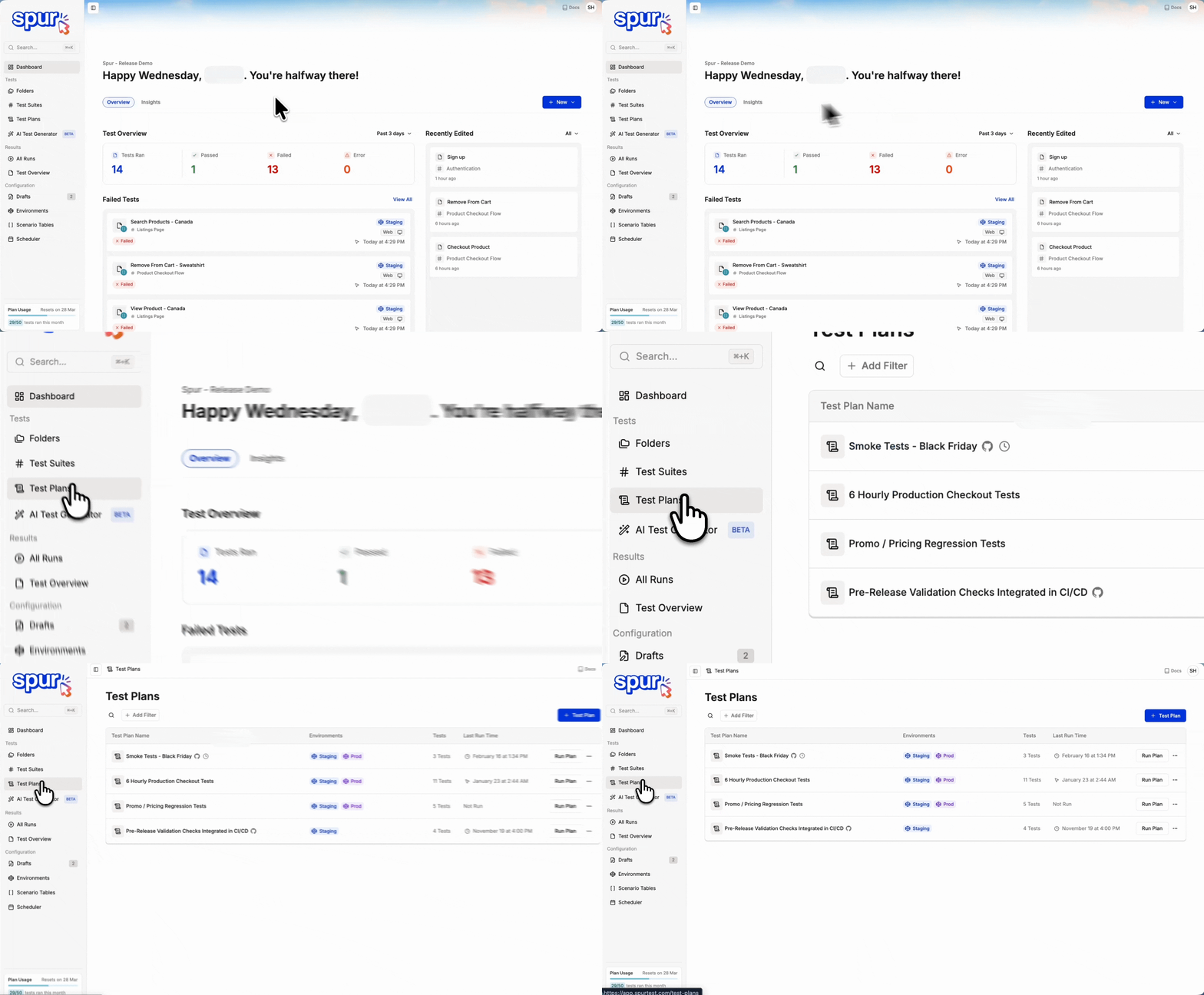 Find the Test Plan you want to run and click **Run Plan** to trigger an immediate run using the saved configuration.
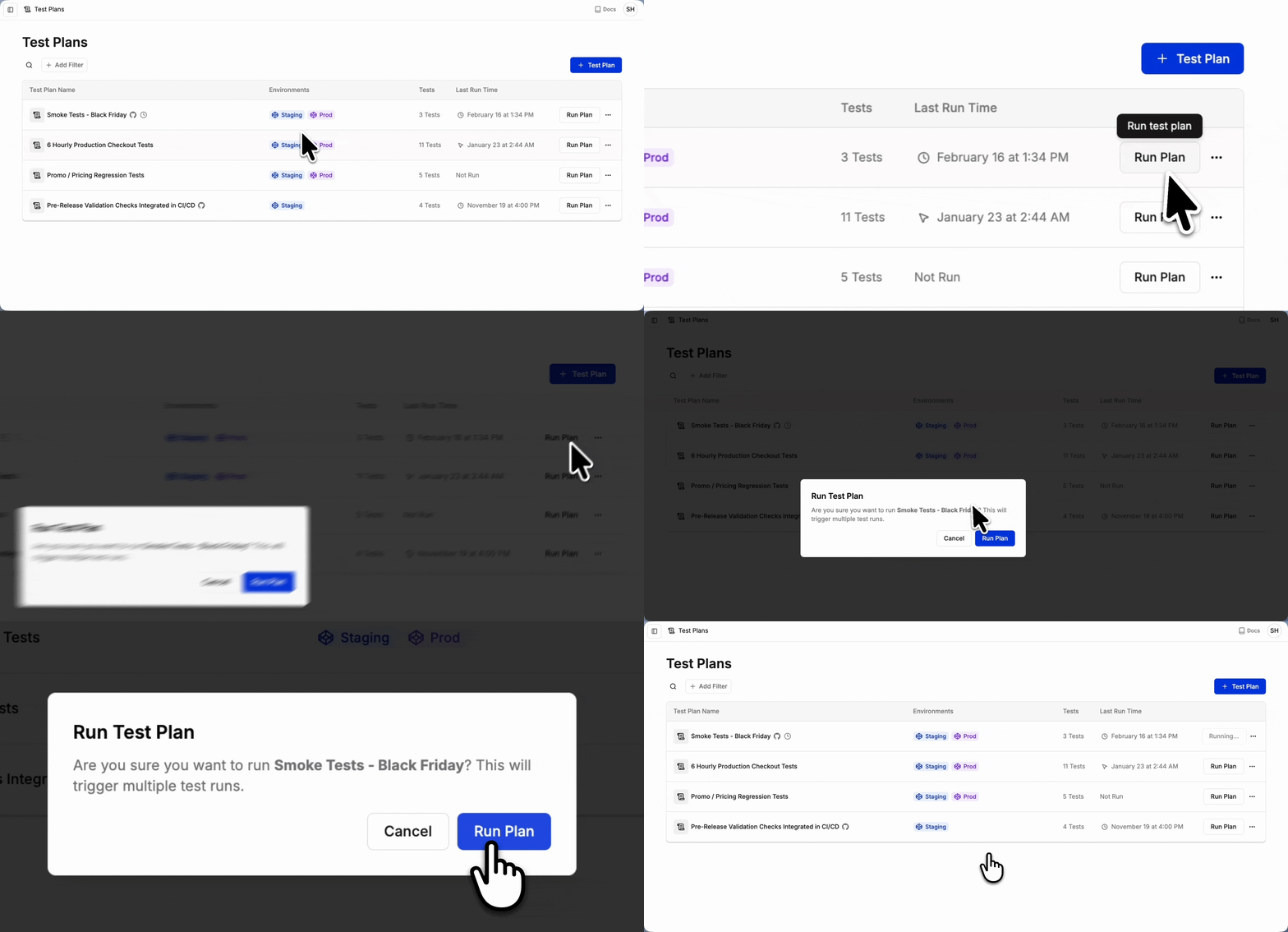 Results appear in the Test Plan's run history as they complete, with a breakdown by suite, environment, and test. Use the [Test Plan Review](/analysing-tests/test-plan-review) flow to triage failures and warnings systematically.
Test Plans can also be triggered automatically via the [Scheduler](/running-tests/scheduler) or your [CI/CD pipeline](/running-tests/CICD) without any manual action.
## Alert Notifications
Keep your team informed without manually checking the dashboard. Connect your [Slack workspace](/analysing-tests/integrations/slack) and choose when to be notified.
* **On finish** — notify when the run completes regardless of outcome
* **On fail** — notify only when one or more tests fail
* **On every run** — notify for every individual test run
* **Final fail** — notify only after all retry attempts have been exhausted and the test is marked as failed
Results appear in the Test Plan's run history as they complete, with a breakdown by suite, environment, and test. Use the [Test Plan Review](/analysing-tests/test-plan-review) flow to triage failures and warnings systematically.
Test Plans can also be triggered automatically via the [Scheduler](/running-tests/scheduler) or your [CI/CD pipeline](/running-tests/CICD) without any manual action.
## Alert Notifications
Keep your team informed without manually checking the dashboard. Connect your [Slack workspace](/analysing-tests/integrations/slack) and choose when to be notified.
* **On finish** — notify when the run completes regardless of outcome
* **On fail** — notify only when one or more tests fail
* **On every run** — notify for every individual test run
* **Final fail** — notify only after all retry attempts have been exhausted and the test is marked as failed
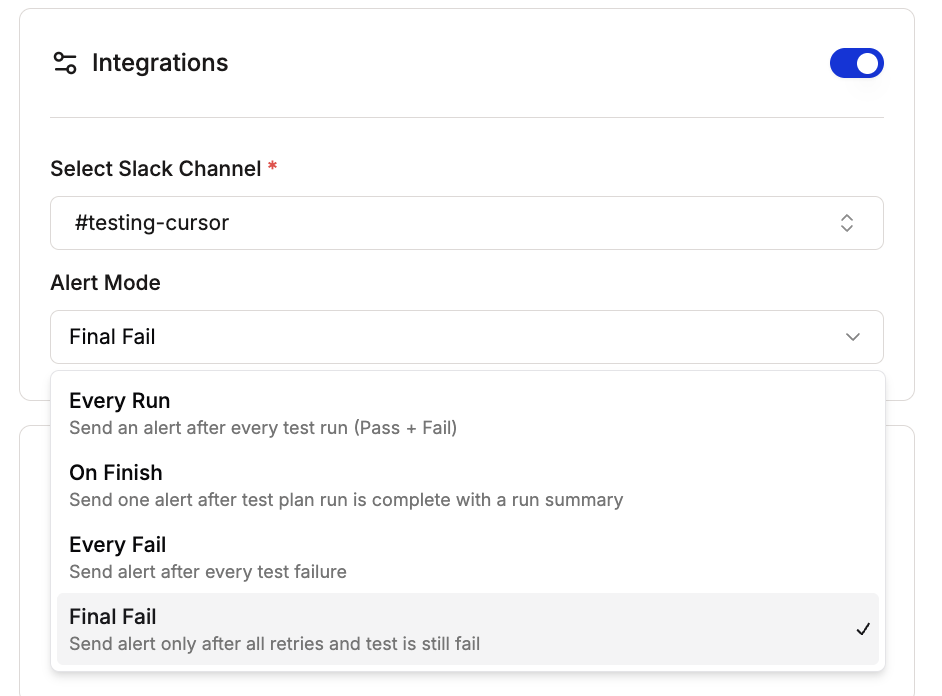 To enable this on an existing Test Plan, [edit your Test Plan](#editing-a-test-plan) and go to the **Additional Settings** tab.
## Auto Retry
Auto Retry helps you distinguish genuine bugs from flaky test results. When enabled, Spur automatically re-runs any failed test up to a set number of attempts before marking it as failed. Retries continue until the test passes or the maximum is reached.
* Choose from 1, 2, or 3 retry attempts
* Maximum is **3 retry attempts** (auto retry is off by default)
To enable this on an existing Test Plan, [edit your Test Plan](#editing-a-test-plan) and go to the **Additional Settings** tab.
## Auto Retry
Auto Retry helps you distinguish genuine bugs from flaky test results. When enabled, Spur automatically re-runs any failed test up to a set number of attempts before marking it as failed. Retries continue until the test passes or the maximum is reached.
* Choose from 1, 2, or 3 retry attempts
* Maximum is **3 retry attempts** (auto retry is off by default)
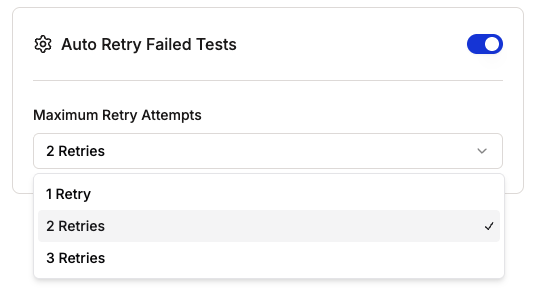 If a test fails once out of three attempts, it is more likely an environmental blip than a real bug. Auto Retry surfaces only the consistent failures worth investigating.
### Retries with Dependencies
If a test that has [dependencies](/authoring-tests/dependencies) fails, Spur re-runs the entire dependency chain, not just the failed test. This ensures the retry starts from a clean state.
For example, if your tests are chained as **Test A > Test B > Test C** and Test B fails:
* Spur re-runs **Test A > Test B**, then continues to **Test C**
* Test A may appear with a retry badge in the results even though it originally passed, because it was re-run as part of the dependency chain
* In some cases, a test that originally passed can fail on the retry
This means you may see retry badges on tests that were not the original point of failure. This is expected behavior when retrying tests with dependencies.
To enable this on an existing Test Plan, [edit your Test Plan](#editing-a-test-plan) and go to the **Additional Settings** tab.
## Editing a Test Plan
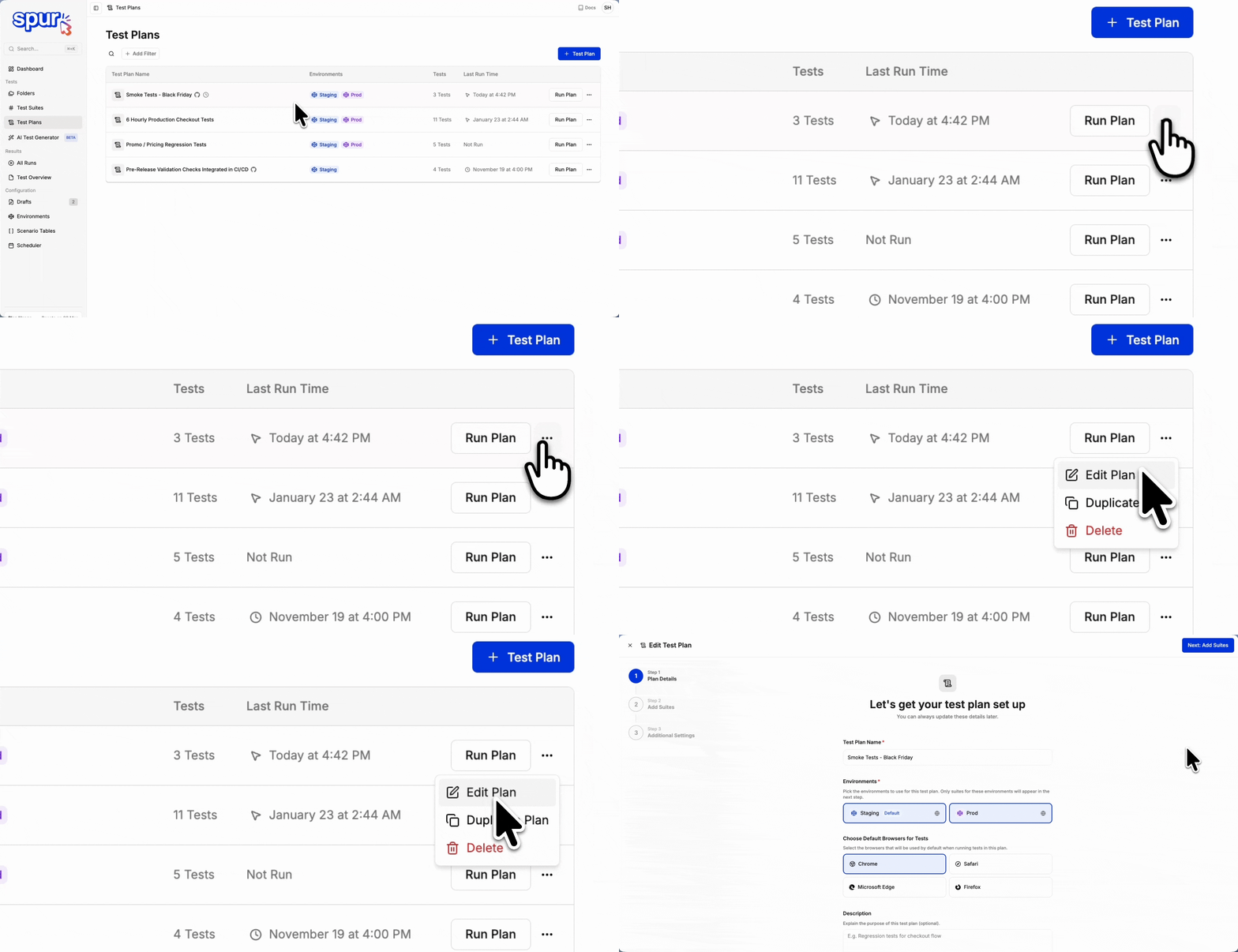
Navigate to **Test Plans**, find the plan you want to edit, click the **three-dot menu**, and select **Edit Test Plan**.
If a test fails once out of three attempts, it is more likely an environmental blip than a real bug. Auto Retry surfaces only the consistent failures worth investigating.
### Retries with Dependencies
If a test that has [dependencies](/authoring-tests/dependencies) fails, Spur re-runs the entire dependency chain, not just the failed test. This ensures the retry starts from a clean state.
For example, if your tests are chained as **Test A > Test B > Test C** and Test B fails:
* Spur re-runs **Test A > Test B**, then continues to **Test C**
* Test A may appear with a retry badge in the results even though it originally passed, because it was re-run as part of the dependency chain
* In some cases, a test that originally passed can fail on the retry
This means you may see retry badges on tests that were not the original point of failure. This is expected behavior when retrying tests with dependencies.
To enable this on an existing Test Plan, [edit your Test Plan](#editing-a-test-plan) and go to the **Additional Settings** tab.
## Editing a Test Plan
Navigate to **Test Plans**, find the plan you want to edit, click the **three-dot menu**, and select **Edit Test Plan**.
 Inside the Test Plan modal, navigate to the **Additional Settings** tab to configure alert notifications and auto retry.
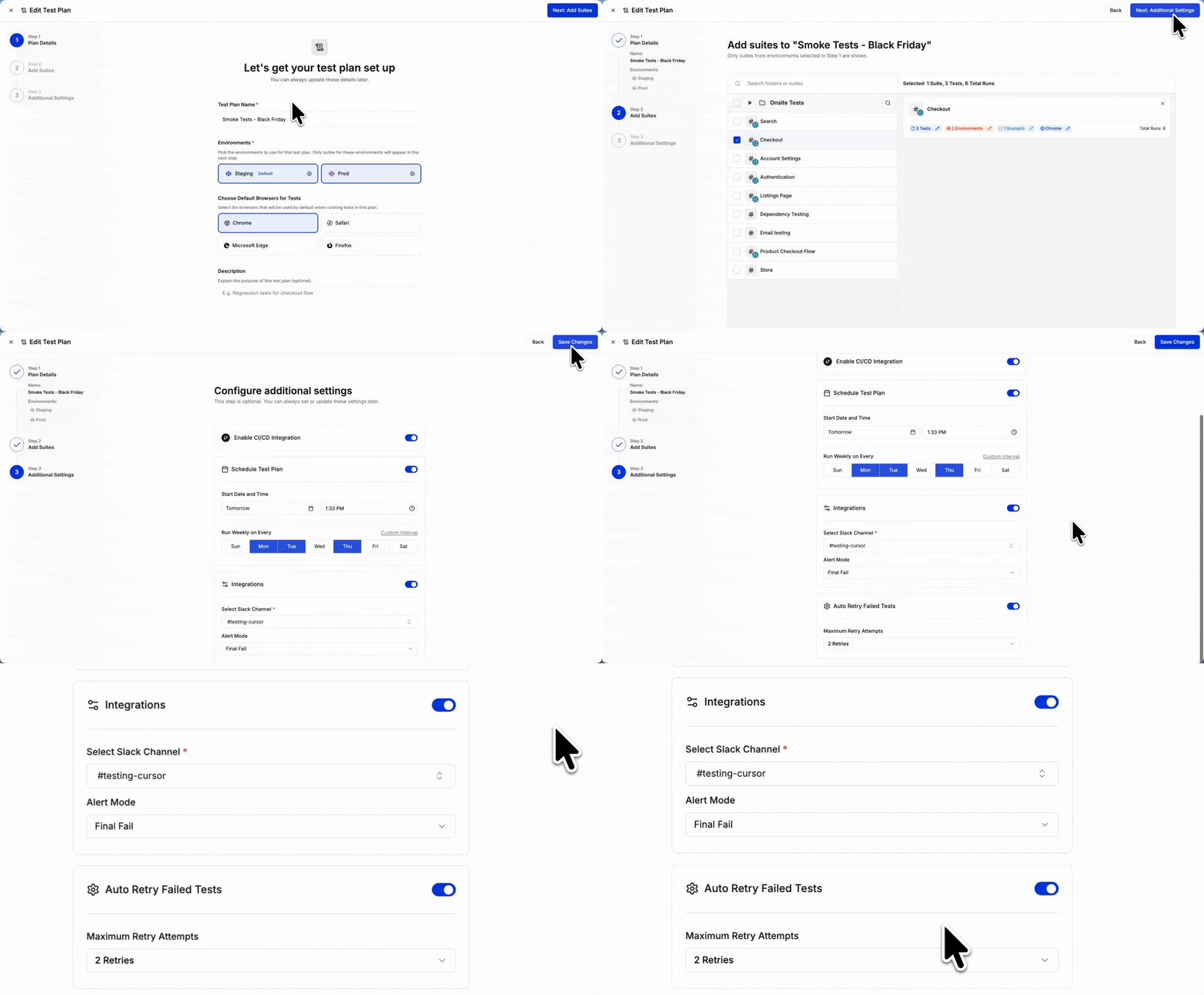 Alert notifications and auto retry can also be configured when creating a new Test Plan.