
What are environments?
An environment represents a specific deployment of your application where tests can be executed. Common examples include:Development
Your local or dev server for early-stage testing
Staging
Pre-production environment for final validation before release
Production
Live production environment for monitoring real user experiences
Feature Branches
Temporary environments for testing new features in isolation
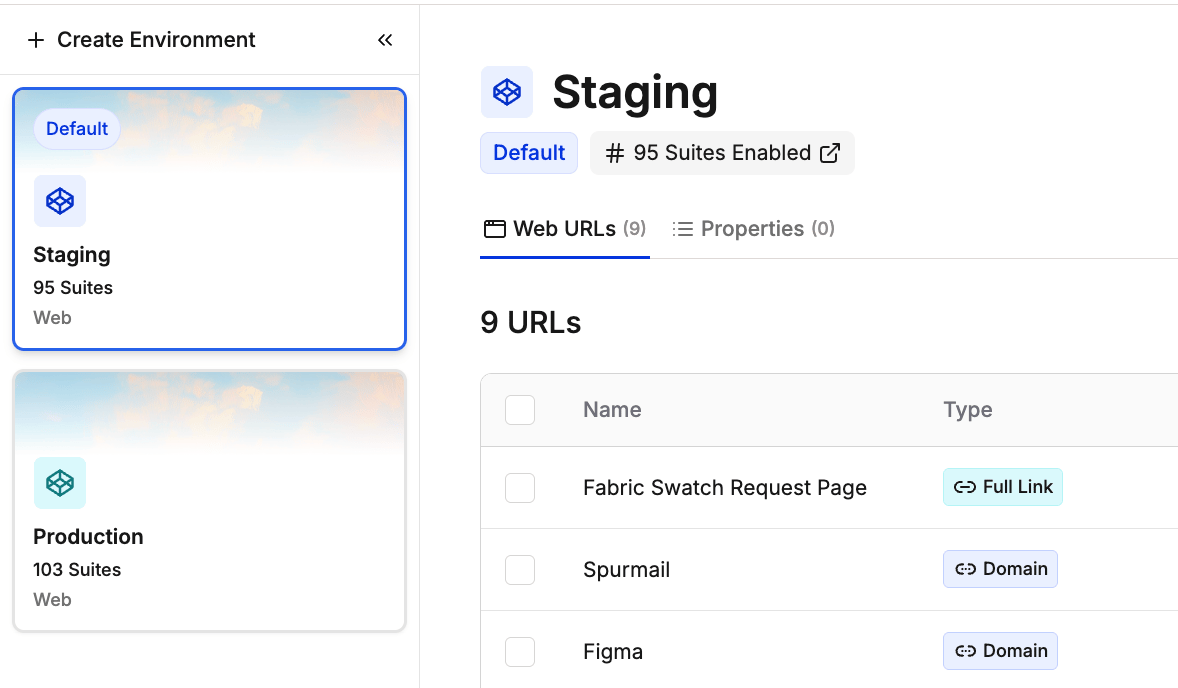
Environments dashboard showing multiple configured environments
Key benefits
No Test Duplication
Write tests once, run them across all environments without copying test code.
Easy Comparison
Compare test results across environments to identify environment-specific issues.
Parallel Testing
Run the same test across multiple environments simultaneously for faster validation.
Environment-Specific Config
Each environment has its own URLs, credentials, and variables that automatically apply.
Link to an environment or property
The Environments page URL tracks your selection: the environment, the tab, and any open property. When you select an environment, switch tabs, or open a property, Spur updates the URL in the address bar. Copy the URL and send it to a teammate. The link opens the same environment, on the same tab, with the same property open.The recipient needs a Spur login with access to the same Application. If the link points to an environment that was deleted or is not in your selected Application, Spur opens your default environment instead.